Weekly-ISH Newsletter: October Update - Budget Hearings, Rogers Schools & Issue 3

Budget Hearings Begin Ahead of the 2027 Session
The Joint Budget Committee is reviewing every state agency's request before lawmakers return in January.

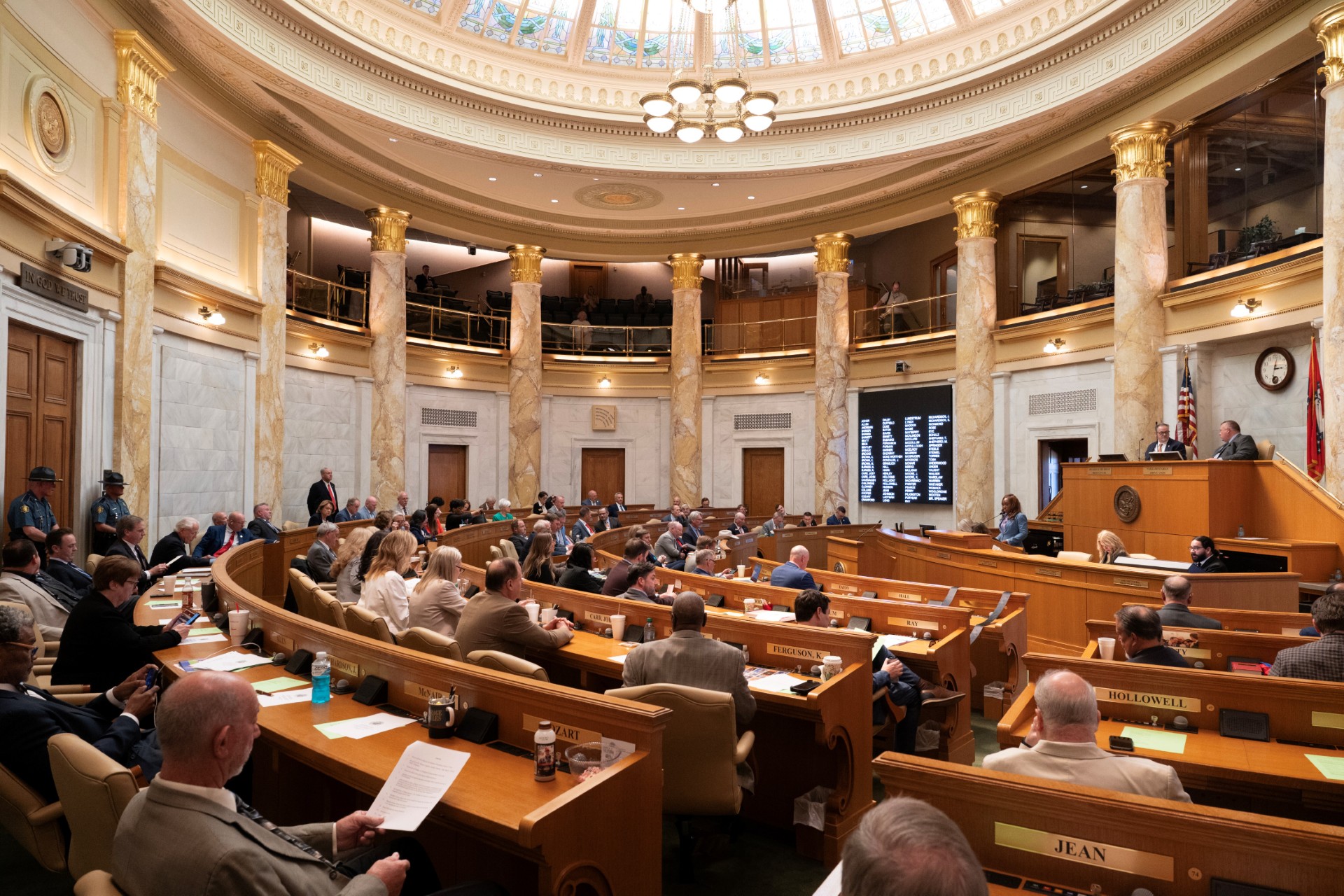
Rep. McKenzie in committee during the 2026 Fiscal Session.
Much of the work on the state budget happens well before the regular session begins. On October 6, the Joint Budget Committee opened its pre-session budget hearings, where each state agency comes before the committee to account for what it has spent and to present its funding request for the next two fiscal years.
The committee is meeting three times a week through the end of October. The Department of Education is scheduled to present on October 28 and the Department of Human Services on October 29, and those two agencies account for the largest share of state spending. The Governor is expected to release her balanced budget proposal in November, which will serve as the starting point for the 2027 Regular Session when it convenes on January 11.
$655M surplus at the close of FY2026
$104M in revenue above forecast in the first quarter
$200M in one-time funds to cover Medicaid
Where Things Stand Heading Into Session
Revenue remains strong. Arkansas closed fiscal year 2026 with a $655 million surplus, and collections for the first three months of this fiscal year are $147 million ahead of last year and $104 million above forecast.
Medicaid is the greatest pressure on the budget. An unexpected rise in claims led the Legislative Council to approve $200 million in one-time funds to cover the shortfall. The federal government has also indicated it will not renew the ARHOME expansion model in its current form, and the state has requested a two-year extension while a new approach is developed.
Agencies have been asked to find savings. The Governor directed cabinet secretaries this summer to reduce costs, and the committee is holding each request to that same standard.
I approach these hearings the same way I approach every appropriation. I ask whether a request funds a core function of government, and whether it grows government or holds the line. A surplus means the state is collecting more than it needs, and I believe that money belongs back with the taxpayers who earned it. I will continue to push for restraint on spending and for further reductions in the income tax.
Take Your Legislator to School Day with Rogers Public Schools
A morning with Rogers students, from pre-K classrooms to Rogers High School.

Visiting with students in a Rogers Public Schools classroom on Take Your Legislator to School Day.
On September 30, I joined Rogers Public Schools for Take Your Legislator to School Day. Much of our work on education happens in committee rooms in Little Rock, and there is no substitute for seeing those policies at work in the classroom.
The morning began with the district's pre-K program. Since the 2020–21 school year, Rogers has expanded pre-K from 12 classrooms to 22, an 83 percent increase in capacity driven by demand from local families. Early learning is one of the best investments we can make in a child's success as a reader, and the district has made it a priority.

Rogers Pre-K has grown from 12 classrooms to 22 since 2020–21.
At Rogers High School, students walked us through the career and technical programs they are part of, from agriculture to hands-on coursework in fields where employers are actively hiring. That is the goal of the ACCESS Act, which asks that every student graduate enrolled, employed, or enlisted, with a clear plan to get there.

A Rogers High School student walks us through her program.
Thank you to the teachers, administrators, and students of Rogers Public Schools for hosting us. I came away with a better understanding of what is working in our schools and several ideas to bring back to Little Rock.
ATLAS Results Show LEARNS Is Working
Third-grade reading proficiency rose from 35 percent to 43 percent in two years.

Reading time in a Rogers Public Schools classroom.
This spring's ATLAS results were the strongest since the LEARNS Act was signed into law. Statewide proficiency across all tested subjects rose from 35 percent in 2024 to 42 percent in 2026, with gains in math (36 to 44 percent), science (36 to 44 percent), and English language arts (34 to 40 percent).
35% → 43% third-grade reading, 2024 to 2026
50% → 66% kindergarten reading, in one year
28% → 23% students at the lowest level
Third-grade reading is the measure I watch most closely, because it marks the point at which students move from learning to read to reading to learn. Third-grade reading proficiency rose from 35 percent to 43 percent over two years, and kindergarten reading proficiency climbed from 50 percent to 66 percent in a single year. The share of students scoring at the lowest performance level also fell, from 28 percent to 23 percent, which tells us the improvement is reaching students across the board.
There is more work to do, as most Arkansas students are not yet proficient. These results confirm, however, that the reforms in LEARNS are moving our schools in the right direction.
As part of the adequacy study, the House and Senate Education Committees have also recommended increasing per-student foundation funding from $8,037 to $8,239 for the 2027–28 school year, along with additional support for dyslexia intervention. These recommendations will be considered as legislation is drafted for the coming session.
Discussing Literacy at the Opportunity Arkansas Summit
A panel on why too many Arkansas students still struggle to read, and what policymakers can do about it.

On the literacy panel at the Homegrown Solutions Summit with Audie Alumbaugh and Gary Newton of Arkansas Learns.
In September, I joined a panel at Opportunity Arkansas's Homegrown Solutions Summit alongside literacy advocate Audie Alumbaugh and Gary Newton, president of Arkansas Learns. Our discussion focused on why too many Arkansas students are still not reading on grade level, and what we can do to change that.
I spoke about the progress we are seeing from the Science of Reading. Instruction grounded in phonics and proven methods is producing results, and the gains are greatest in the early grades, where a strong foundation in reading shapes everything that follows. The ATLAS results above reflect that progress. Our responsibility now is to stay the course, continue supporting teachers in this work, and resist efforts to return to approaches that did not serve our students.
Why I Am Voting Against Issue 3
Early voting is underway, and Election Day is Tuesday, November 3.
Issue 3 is a proposed constitutional amendment that the legislature referred to voters in 2025. I am strongly opposed to it, and I encourage you to vote against it. An August Talk Business & Politics–Hendrix College poll found 37 percent of likely voters in favor, 25 percent opposed, and 38 percent undecided, so the outcome rests with voters who have not yet made up their minds.
Issue 3 would write a permanent power into the Arkansas Constitution allowing cities and counties to create economic development districts. Property inside a district would be exempted from ordinary taxes and charged by the district instead, and the district could issue its own bonds outside constitutional debt limits. The amendment itself creates no district. The rules governing how these districts operate would be written later.
The most detailed version of those rules we have seen is SB647, the sponsor's implementing bill. It was filed on the last day of the 2025 session and sent to interim study, and its effective date depended on voters approving Issue 3. It is not law, but it is the best written guide we have to what Issue 3 would look like in practice.
Three Reasons to Vote No
Taxing power can move to appointed boards. Under SB647, a district can be governed by a board of five to nine members appointed by a mayor or county judge. That board could add charges of up to 10 percent on top of the existing property and sales tax rates without a district-wide election.
The framework comes before the rules. The constitutional authority would be permanent, while the safeguards are left to future legislation. Voters are being asked to approve the power first and learn the rules later.
The sales pitch outruns the paper. Supporters promise no new taxes and no revenue impact. The state's own fiscal impact statement projects decreased property tax collections for local taxing entities, and SB647 allows local governments to guarantee district bonds, putting public revenue on the hook if projects fall short.
The scope matters as well. Arkansas already allows tax increment financing under Amendment 78 for roads, utilities, and public facilities. SB647 goes much further, reaching retail, restaurants, entertainment, and hospitality, with tools that include cash grants, forgivable loans, below-market loans, and abatements lasting up to 30 years. At that point the question is no longer about infrastructure. It is about whether government should be selecting which private businesses win.
I am pro-growth, and I want to see continued investment in Northwest Arkansas. Prosperity, however, does not come from government-selected deals financed with someone else's risk. We can pursue growth without moving taxing power away from voters, approving rules we have not seen, or putting public revenue behind private projects. I will be voting against Issue 3, and I hope you will join me.
Benton County early voting locations and hours are available at vote.bentoncountyar.gov.
District Spotlight: The War Eagle Craft Fair
More than seventy years of Ozark craftsmanship on the banks of the War Eagle River.
Every October, visitors from across the region make their way to the banks of the War Eagle River for the War Eagle Craft Fair, one of the oldest and most treasured traditions in Northwest Arkansas.
The fair began in 1954, when Blanche and Lester Elliott, concerned that traditional Ozark crafts were disappearing, hosted a small exhibition of handmade work in their home at War Eagle Mills Farm. Pottery, quilts, woodcarvings, and baskets were on display, and according to the sign-in books, 2,259 people attended that first year.
More than seventy years later, the fair draws hundreds of exhibitors and close to 200,000 visitors each fall. It is run by the nonprofit Ozark Arts and Crafts Fair Association, which accepts no grants or outside funding and reinvests what it raises back into the fair. Over the years, it has also supported scholarships at schools in Arkansas and Missouri.

The McKenzie family at the War Eagle Craft Fair this October.
Our family made the trip again this year, and it remains one of our favorite fall traditions. If you have not been, I encourage you to put it on your calendar for next October.